Global Anti-Aging Products Market Research Report 2025-2030
THE GLOBAL ANTI-AGING PRODUCTS MARKET WAS VALUED AT USD 52.32 BILLION IN 2024 AND IS PROJECTED TO REACH USD 78.34 BILLION BY 2030, GROWING AT A CAGR OF 6.96% DURING THE FORECAST PERIOD
The Anti-Aging Products Market Size, Share & Trends By Product, By Application, By Gender, By Distribution Channel, By Geography. The Industry Analysis Includes Market Size and Value (in USD Billions) for the Listed Segments, With Data Spanning 10 Years.
Published Date : October 2025
Last Updated : October 2025
format: PDF

138 pages

06 tables

38 charts

5 region

16 countries

25 company

5 segments
Purchase Options
Global Anti-Aging Products Market Research Report 2025-2030
THE GLOBAL ANTI-AGING PRODUCTS MARKET WAS VALUED AT USD 52.32 BILLION IN 2024 AND IS PROJECTED TO REACH USD 78.34 BILLION BY 2030, GROWING AT A CAGR OF 6.96% DURING THE FORECAST PERIOD
The Anti-aging Products Market Size, Share & Trend Analysis Report By
- Product: Creams, Lotions & Moisturizers, Serums & Concentrates, Facial Oils, and Others
- Application: Anti-Wrinkle, Anti-Pigmentation, and Others
- Gender: Women and Men
- Distribution Channel: Offline and Online
- Geography: North America, Europe, APAC, Middle East & Africa, and Latin America
Industry Analysis Report, Regional Outlook, Growth Potential, Price Trends, Competitive Market Share & Forecast 2025–2030.
This report includes market data points, ranging from trend
analyses to market estimates & forecasts that you can customize
ANTI-AGING PRODUCTS MARKET REPORT SCOPE
| REPORT ATTRIBUTE | DETAILS |
|---|---|
| Market Size (2030) | USD 78.34 Billion |
| Market Size (2024) | USD 52.32 Billion |
| CAGR (2024-2030) | 6.96% |
| HISTORIC YEAR | 2021-2023 |
| BASE YEAR | 2024 |
| FORECAST YEAR | 2025-2030 |
| LARGEST REGION (2024) | North America |
| SEGMENTS BY | Product, Application, Gender, Distribution Channel, and Geography |
| GEOGRAPHIC ANALYSIS | North America, Europe, APAC, Latin America, and the Middle East & Africa |
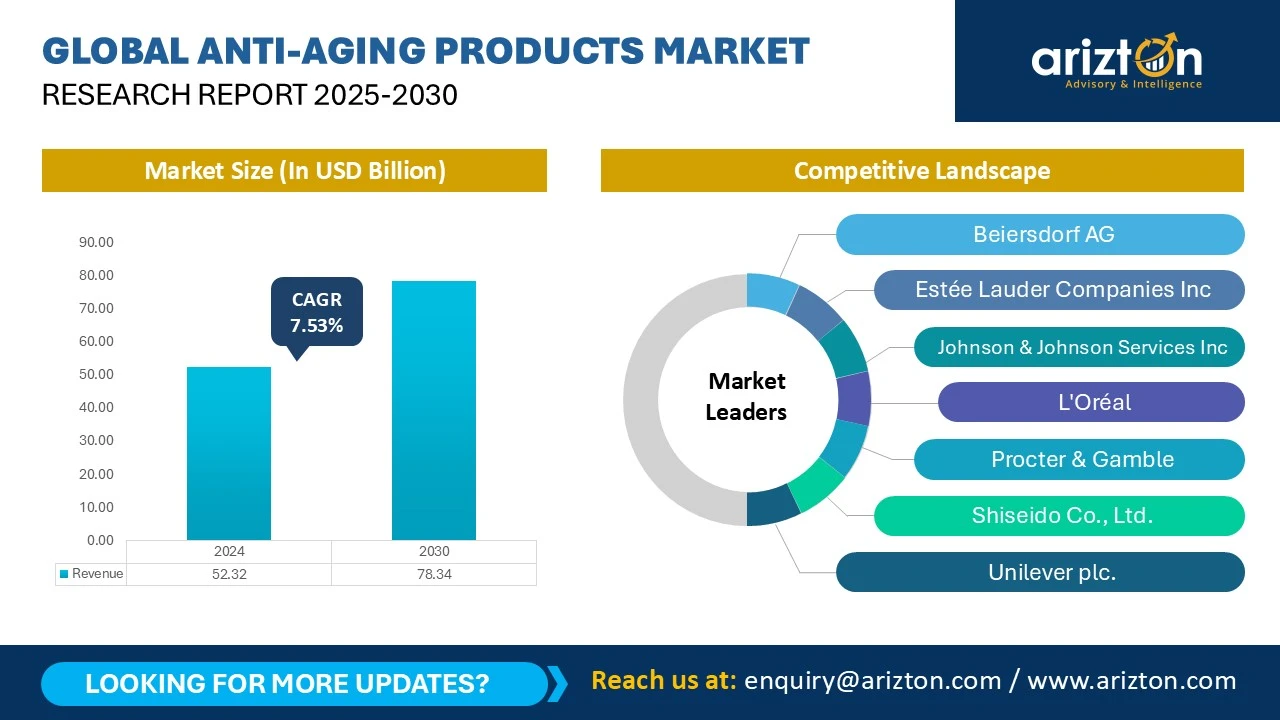
| KEY PLAYERS | Beiersdorf AG, Estée Lauder Companies Inc., Johnson & Johnson Services Inc., L'Oréal, Procter & Gamble, Shiseido Co., Ltd., and Unilever plc. |
ANTI-AGING PRODUCTS MARKET SIZE & SHARE
The global anti-aging products market was valued at USD 52.32 billion in 2024 and is projected to reach USD 78.34 billion by 2030, growing at a CAGR of 6.96% during the forecast period. The market is growing significantly, driven by several factors including technological advancements and product innovation, clean beauty trends, and the rising demand for personalization. In addition, the increasing demand for men’s grooming, an aging population, the preventive skincare from a younger age, digital engagement, and growing interest in skin health are further contributing to the market’s growth.
ANTI-AGING PRODUCTS MARKET NEWS
- In 2024, Beiersdorf AG, a German-based multinational company of personal care products, made a strategic partnership with Rubedo Life Sciences, Inc., a biopharmaceutical company. It helps them to develop a breakthrough anti-aging solution for the global face care market.
- In 2025, Estee Lauder Companies Inc. announced a collaboration with Serpin Pharma, a biotechnology company. They aim to offer skin care longevity benefits to consumers. It helps to accelerate transformative product innovation.
KEY TAKEAWAYS
- Market Growth: The global anti-aging products market size was valued at USD 52.32 billion in 2024 and is projected to reach USD 78.34 billion by 2030, growing at a CAGR of 6.96% during the forecast period.
- By Product: The creams, lotions & moisturizers segment accounted for the largest market share of over 45%.
- By Application: The anti-wrinkle segment dominates and holds the largest market share.
- By Gender: The men segment shows the highest growth of 7.88% during the forecast period.
- By Distribution Channel: The offline segment holds the largest global anti-aging products market share.
- By Geography: North America leads the global anti-aging products market with the largest share of over 34%.
- Growth Factor: The global anti-aging products market is set to grow due to an aging population and increasing preventive skincare from a younger age.
ANTI-AGING PRODUCTS MARKET TRENDS
Advancement & Product Innovation
The advancement & product innovation is a trend in the global anti-aging products market. It is driven by several factors, including the rise of prejuvenation, rising demand for proven efficacy, integration of new formulations into daily routines, desire for customization & personalization, and influence of clean beauty. Product innovation is showing promising growth in the global anti-aging products market due to several factors, including targeted functionalities, ethical sourcing, and accessibility. Manufacturers are continuously investing in R&D activities to create new and innovative anti-aging products, as consumers’ demand for effective and natural skin health solutions has increased significantly.
Clean Beauty Trends
The clean beauty trend in the global market is fueling the growth of anti-aging products. It is driven by several factors, such as an increased demand for recognizable & natural ingredients, increased environmental & ethical consciousness, concerns about artificial additives, shift from anti-aging to healthy longevity, and premiumization in the market. The consumers, especially Millennials and Gen Z, are actively seeking information about the products on online platforms that demand clean beauty. They are actively seeking ingredient labels that increase transparency in the market. The demand for clean beauty is creating stronger competition among the market players. Thus, the brand has differentiated itself with manufacturing processes, ethical practices, and ingredient sourcing.
ANTI-AGING PRODUCTS MARKET DRIVERS
Aging Population
An aging population is a crucial and major factor driving the growth of the anti-aging products market across the globe. Several factors drive it: increased disposable income, increased focus on health & well-being, and an active lifestyle. The older population is more proactive as compared to previous generations about health & wellness. They want to slow down the aging signs and look for healthy longevity. This generation is more engaged in life and has a more active lifestyle. It drives the demand for products that align with a healthy lifestyle and are more effective.
Preventive Skincare from a Younger Age
Preventive skincare from a younger age is a significant driver in the global anti-aging products market. It is driven by several factors: the rise of prejuvenation, increased skincare awareness & education, concern beyond wrinkles, social media influence, and the clean beauty movement. The rise of prejuvenation is most prevalent among Millennials and Gen Z, who are adopting anti-aging products in their early 20s. The focus has shifted from reactive to a healthy longevity of a proactive mindset. They are investing heavily in a future youthful appearance.
INDUSTRY RESTRAINTS
High Cost
The high cost is impacting the anti-aging products market in various ways, including slow growth, limited accessibility, price sensitivity, and competition. It may restrict the price-sensitive people from buying such products. The high cost of anti-aging products is a direct reflection of the various investments that are required for bringing them to the market. It includes high-potency ingredients, premium packaging & marketing, rigorous regulations & efficacy testing, and extensive research & development. Sourcing clinically proven ingredients like advanced peptides, hyaluronic acid, and vitamin C derivatives can be more expensive. The use of sustainably sourced or rare plant-based ingredients can also add to the cost. It increases the overall cost of the anti-aging product.
ANTI-AGING PRODUCTS MARKET SEGMENTATION INSIGHTS
INSIGHTS BY PRODUCT
The global anti-aging products market by product is segmented into creams, lotions & moisturizers, serums & concentrates, facial oils, and others. The creams, lotions & moisturizers segment accounted for the largest market share of over 45%. It is driven by several factors, including trust and familiarity, skin barrier protection, everyday routine use, mainstream accessibility, and multi-functionality. Creams, lotions, and moisturizers are widely trusted by consumers, as people are more familiar with them for skincare applications, making their use more comfortable. They are the most traditional and ideal products for daily skincare routines, which drives the demand for anti-aging products in the global market during the forecast period.
The growing focus on skin longevity is further fueling demand for this segment, as it provides greater hydration and long-term vitality. In the APAC region, demand is rising significantly due to increasing disposable incomes and growing interest in anti-aging products.
INSIGHTS BY APPLICATION
The global anti-aging products market by application is categorized into anti-wrinkle, anti-pigmentation, and others. The anti-wrinkle segment dominates and holds the largest market share. The market is driven by several factors, including the growing aging population, demand for skincare alternatives, increased tech-savvy population and screen time, technological advancements in ingredients, the influence of social media, and rising disposable income.
The aging population is a major driver of the global anti-wrinkle products market. Individuals aged 40 and above are more concerned about visible signs of aging, which pushes them to purchase anti-wrinkle products. Modern lifestyles, such as prolonged use of computers and smartphones, are also linked to premature signs of aging, including horizontal neck lines and fine lines around the eyes. This has expanded the consumer base seeking anti-wrinkle products for preventive care, thereby driving demand in the global market during the forecast period.
INSIGHTS BY GENDER
Based on gender, the men segment shows significant growth, with the fastest-growing CAGR of 7.88% during the forecast period. The segment is driven by several factors, including the growing grooming culture, active lifestyles, targeted formulation innovation, the influence of social media influencers, and tailored products. In today’s competitive professional world, men are seeking products that help them look healthy, youthful, and energized to maintain a competitive edge. They are increasingly showing interest in grooming services such as skincare, facials, and overall wellness, becoming more aware of the importance of self-care.
Male consumers also prefer multi-functional products, which has encouraged brands offering such solutions to gain strong traction. In addition, men value the privacy and convenience of online shopping, with subscription boxes that provide hassle-free routines further fueling the demand for anti-aging products in the global market.
INSIGHTS BY DISTRIBUTION CHANNEL
Based on the distribution channel, the offline segment holds the largest global anti-aging products market share. Offline distribution channels for anti-aging products include supermarkets, hypermarkets, drugstores, pharmacies, specialty stores, and departmental stores. Growth in this segment is driven by factors such as immediate gratification, personalized consultations, tailored recommendations, the “try before you buy” trend, and opportunities for brand discovery.
Supermarkets and hypermarkets represent the largest category within offline distribution channels in the global anti-aging products market. These stores typically offer well-established brands with high accessibility and visibility to a wide customer base. In developed countries, consumers increasingly prefer purchasing anti-aging products alongside groceries and household items from supermarkets and hypermarkets.
Furthermore, the rising demand for organic and natural anti-aging products is significantly contributing to growth in this segment, reinforcing the importance of supermarkets and hypermarkets in the global anti-aging products market during the forecast period.
ANTI-AGING PRODUCTS MARKET GEOGRAPHICAL ANALYSIS
North America leads the global anti-aging products market with the largest share of over 34%. The market is driven by several factors, including high consumer awareness, the longevity economy and aging population, innovations and technological advancements, stringent regulations, personalization trends, and the “beauty from within” movement.
The US dominates the regional market due to advancements in technology and innovation, a strong focus on longevity, and heightened skin health awareness. Meanwhile, Canada is emerging as one of the fastest-growing countries in the North American anti-aging products market.
Well-informed consumers are seeking solutions that support skin longevity, integrity, and a youthful appearance. This demand is further fueled by health-centric messaging, social media, and influencer marketing. The “beauty from within” trend is encouraging consumers to purchase high-quality, natural ingredient–based anti-aging products. As a result, companies are increasingly adopting natural ingredients in product formulations and targeting consumers who prioritize natural skincare, which is expected to drive market growth during the forecast period.
ANTI-AGING PRODUCTS MARKET VENDOR LANDSCAPE
The global anti-aging products market report consists of exclusive data on 25 vendors. The market is highly competitive and fragmented, comprising a mix of established global players, small companies, and niche brands. Larger players are heavily investing in the development of new products to attract a wider consumer base and maintain competitiveness. In contrast, niche companies focus on offering highly affordable, single-ingredient serums, leveraging their agility to introduce innovative products by engaging directly with consumers and delivering authentic solutions.
Companies are also investing significantly in R&D to deliver new solutions and secure patents. In addition, larger firms are actively acquiring successful brands to fill portfolio gaps. Competition among players remains intense, as rapid advancements in technology and formulations raise consumer expectations for continual innovation and upgrades in anti-aging products.
SNAPSHOT
The global anti-aging products market size is expected to grow at a CAGR of approximately 6.96% from 2024 to 2030.
Base Year: 2024
Forecast Year: 2025-2030
The report considers the present scenario of the global anti-aging product and its market dynamics for 2025−2030. It covers a detailed overview of several market growth enablers, restraints, and trends. The study covers both the demand and supply sides of the market. It also profiles and analyzes leading companies and several other prominent companies operating in the market.
Key Vendors
- Beiersdorf AG.
- Business Overview
- Product Offerings
- Key Developments
- Key Strategies
- Key Opportunities
- Key Strengths
- Estée Lauder Companies Inc.
- Johnson & Johnson Services Inc.
- L'Oréal
- Procter & Gamble
- Shiseido Co., Ltd.
- Unilever plc.
Other Prominent Vendors
- AbbVie Inc.
- Business Overview
- Product Offerings
- Age Sciences Inc.
- Amway Corp.
- Clarins
- Coty Inc.
- Galderma
- Kao Corporation
- Natura &Co
- Nu Skin Enterprises
- Oriflame Holding AG
- Pierre Fabre
- Revlon, Inc.
- Amorepacific Corporation
- Caudalie
- BIODERMA
- COOLA LLC
- Lotus Herbals
- Rohto Pharmaceutical Co., Ltd.
SEGMENTATION & FORECASTS
- By Product
- Creams, Lotions & Moisturizers
- Serums & Concentrates
- Facial Oils
- Others
- By Application
- Anti-Wrinkle
- Anti-Pigmentation
- Others
- By Gender
- Women
- Men
- By Distribution Channel
- Offline
- Online
- By Geography
- North America
- US
- Canada
- Europe
- Germany
- France
- UK
- Italy
- Spain
- APAC
- China
- Japan
- South Korea
- India
- Latin America
- Brazil
- Mexico
- Middle East & Africa
- South Africa
- Turkey
- Saudi Arabia
ANTI-AGING PRODUCTS MARKET FAQs
How big is the global anti-aging products market?
What is the growth rate of the global anti-aging products market?
Who are the major players in the global anti-aging products market?
What are the key drivers of the global anti-aging products market?
EXHIBIT 1 Global Anti-Aging Products Market 2021-2030 ($ billion)
EXHIBIT 2 Global Anti-Aging Products Market by Product 2021-2030 ($ billion)
EXHIBIT 3 Market by Creams, Lotions & Moisturizers 2021-2030 ($ billion)
EXHIBIT 4 Market by Serums & Concentrates 2021-2030 ($ billion)
EXHIBIT 5 Market by Facial Oils 2021-2030 ($ billion)
EXHIBIT 6 Market by Others 2021-2030 ($ billion)
EXHIBIT 7 Global Anti-Aging Products Market by Application 2021-2030 ($ billion)
EXHIBIT 8 Market by Anti-Wrinkle 2021-2030 ($ billion)
EXHIBIT 9 Market by Anti-Pigmentation 2021-2030 ($ billion)
EXHIBIT 10 Market by Others 2021-2030 ($ billion)
EXHIBIT 11 Global Anti-Aging Products Market by Gender 2021-2030 ($ billion)
EXHIBIT 12 Market by Women 2021-2030 ($ billion)
EXHIBIT 13 Market by Men 2021-2030 ($ billion)
EXHIBIT 14 Global Anti-Aging Products Market by Distribution Channel 2021-2030 ($ billion)
EXHIBIT 15 Market by Offline 2021-2030 ($ billion)
EXHIBIT 16 Market by Online 2021-2030 ($ billion)
EXHIBIT 17 Global ANTI-AGING PRODUCTS Market by Geography 2021-2030 ($ billion)
EXHIBIT 18 North America Anti-Aging Products 2021-2030 ($ billion)
EXHIBIT 19 US Anti-Aging Products 2021-2030 ($ billion)
EXHIBIT 20 Canada Anti-Aging Products 2021-2030 ($ billion)
EXHIBIT 21 Europe Anti-Aging Products 2021-2030 ($ billion)
EXHIBIT 22 Germany Anti-Aging Products 2021-2030 ($ billion)
EXHIBIT 23 France Anti-Aging Products 2021-2030 ($ billion)
EXHIBIT 24 UK Anti-Aging Products 2021-2030 ($ billion)
EXHIBIT 25 Italy Anti-Aging Products 2021-2030 ($ billion)
EXHIBIT 26 Spain Anti-Aging Products 2021-2030 ($ billion)
EXHIBIT 27 APAC Anti-Aging Products 2021-2030 ($ billion)
EXHIBIT 28 China Anti-Aging Products 2021-2030 ($ billion)
EXHIBIT 29 Japan Anti-Aging Products 2021-2030 ($ billion)
EXHIBIT 30 South Korea Anti-Aging Products 2021-2030 ($ billion)
EXHIBIT 31 India Anti-Aging Products 2021-2030 ($ billion)
EXHIBIT 32 Latin America Anti-Aging Products 2021-2030 ($ billion)
EXHIBIT 33 Brazil Anti-Aging Products 2021-2030 ($ billion)
EXHIBIT 34 Mexico Anti-Aging Products 2021-2030 ($ billion)
EXHIBIT 35 Middle East & Africa Anti-Aging Products 2021-2030 ($ billion)
EXHIBIT 36 South Africa Anti-Aging Products 2021-2030 ($ billion)
EXHIBIT 37 Turkey Anti-Aging Products 2021-2030 ($ billion)
EXHIBIT 38 Saudi Arabia Anti-Aging Products 2021-2030 ($ billion)
LIST OF TABLES
TABLE 1 Global Anti-Aging Products Market 2021-2030 ($ billion)
TABLE 2 Global Anti-Aging Products Market by Product Segment 2021-2030 ($ billion)
TABLE 3 Global Anti-Aging Products Market by Application Segment 2021-2030 ($ billion)
TABLE 4 Global Anti-Aging Products by Gender Segment 2021-2030 ($ billion)
TABLE 5 Global Anti-Aging Products by Distribution Channel Segment 2021-2030 ($ billion)
TABLE 6 Global Anti-Aging Products by Geography 2021-2030 ($ billion)
CHAPTER – 1: Global Anti-Aging Products Market Overview
- Executive Summary
- Key Findings
- Key Developments
CHAPTER – 2: Global Anti-Aging Products Market Segmentation Data
- Product Market Insights (2021-2030)
- Creams, Lotions & Moisturizers
- Serums & Concentrates
- Facial Oils
- Others
- Application Market Insights (2021-2030)
- Anti-Wrinkle
- Anti-Pigmentation
- Others
- Gender Market Insights (2021-2030)
- Women
- Men
- Distribution Channel Market Insights (2021-2030)
- Offline
- Online
CHAPTER – 3: Global Anti-Aging Products Market Prospects & Opportunities
- Global Anti-Aging Products Market Drivers
- Global Anti-Aging Products Market Trends
- Global Anti-Aging Products Market Constraints
CHAPTER – 4: Global Anti-Aging Products Market Overview
- Global Anti-Aging Products Market -Competitive Landscape
- Global Anti-Aging Products Market - Key Players
- Global Anti-Aging Products Market - Key Company Profiles
CHAPTER – 5: Appendix
- Research Methodology
- Abbreviations
- Arizton
Select a license type that suits your business needs
Single User Licence
- Report accessible by one user only
- Free 10% or 3 days of customization
- Free post-sale service assistance
- Continuous support through email
5 User Licence
- Report accessible by 5 users within the organization
- Free 15% or 4.5 days of customization
- Continuous support through email and telephone
- Free analyst hour
- Free Upgrade: If an updated report published within 180 days of purchase, you will get the revised report free of charge
Corporate Licence
- Free Datasheet worth $1500
- Report accessible by the entire organization
- Free 20% or 6 days of customization
- Free post-sale service assistance
- Continuous support through email and telephone
- Direct access to lead analysts
- Free analyst hour
- Free Upgrade: If an updated report published within 180 days of purchase, you will get the revised report free of charge
Datasheet Licence
- Report accessible by 1 user only
- Free 15% or 32 hours of customization
- Free post-sale service assistance
- Direct access to lead analysts
Frequently Asked Questions
How big is the global anti-aging products market?
What is the growth rate of the global anti-aging products market?
Who are the major players in the global anti-aging products market?
What are the key drivers of the global anti-aging products market?