US Hyperscale Operators Are Racing to Solve Power Before Space
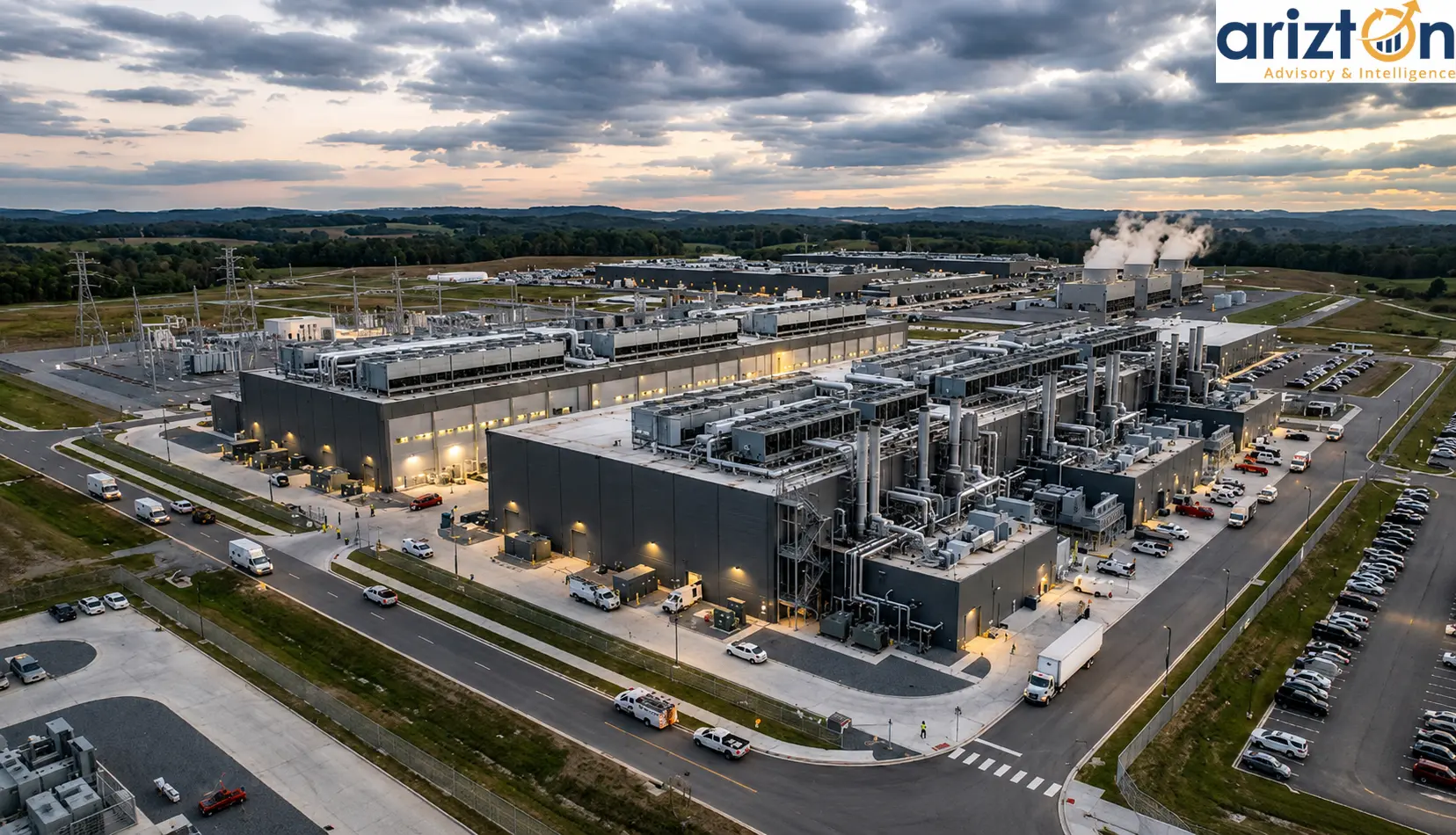
The US hyperscale data center market sits at the center of the AI buildout, where every gigawatt of new capacity has become a competitive asset. Operators are no longer just adding square footage, they're racing to secure the power, land, and cooling infrastructure needed to keep pace with GPU-driven demand.
What Is Driving Growth in the US Hyperscale Data Center Market?
Investment in the US hyperscale data center market reached USD 307.18 billion in 2025 and is projected to climb to USD 697.84 billion by 2031, growing at a CAGR of 14.66%. That trajectory is being pulled almost entirely by artificial intelligence. As GPU-based training and inference workloads scale, operators are converting older facilities and breaking ground on new campuses faster than at any point in the market's history. Lambda's Kansas City project, which is repurposing a vacant 2009 facility into an AI factory running over 10,000 NVIDIA Blackwell Ultra GPUs, captures how quickly this urgency is reshaping construction timelines.
- Investment nearly doubled in 2025 versus 2024.
- Google committed $9 billion to Oklahoma, including two new Muskogee County campuses.
- AWS is building an 18-building, $5 billion campus in Texas designed to run on nuclear power
Know More: https://www.arizton.com/market-reports/united-states-hyper-scale-data-center-market
Who Are the Leading Companies in the US Hyperscale Data Center Market?
The market is led by a mix of hyperscale owner-operators and colocation specialists, including Apple, Amazon Web Services, CyrusOne, DataBank, Digital Realty, Equinix, Google, Meta, Microsoft, NTT DATA, and Vantage Data Centers. Behind them sits a dense supplier base spanning NVIDIA, Dell Technologies, HPE, Cisco, Broadcom, and Intel, which equip these facilities with compute, storage, and networking hardware.
Which Hyperscale Data Center Providers Offer the Largest Facilities in the US?
Meta currently holds the scale record with its nine-building, four-million-square-foot campus in Monroe, Louisiana, under construction since December 2024 and continuing through 2030. AWS's planned Texas campus, with roughly 18 two-story buildings and over $5 billion in investment, follows closely. Google's two-campus Oklahoma expansion and Goodman Group's 32 MW LAX01 facility in Los Angeles round out the recent list of major builds.
Who Are the Major Providers of Cloud Infrastructure and Colocation Services for Hyperscale Needs?
Businesses that need hyperscale-grade capacity without owning the physical infrastructure typically work with colocation and cloud infrastructure providers rather than the hyperscalers themselves. Equinix, Digital Realty, CyrusOne, DataBank, Vantage Data Centers, and NTT DATA lease rack space, power, and connectivity to enterprises and smaller cloud operators, effectively extending hyperscale-grade capability to tenants without hyperscaler-level capital budgets.
Where Can I Find the Top Hyperscale Data Center Locations Across the US?
Five regional clusters define the market. The Southeast, led by South Carolina and Louisiana, is seeing major Meta investment. The Midwest, anchored by Ohio, Iowa, Illinois, and Missouri, draws operators with renewable energy access and tax incentives, though Lordstown, Ohio's recent ban on new data center proposals signals growing local pushback. The Southwest, led by Texas and Arizona, and the West, spanning Nevada, California, Utah, Oregon, and Idaho, remain strong on connectivity and incentives. The Northeast, particularly the New York-New Jersey corridor, continues to grow as a financial-sector connectivity hub.
How Can Businesses Compare Hyperscale Data Center Services Available in the United States?
The most useful comparison points are power density per rack, cooling technology, renewable energy sourcing and PPA commitments, regional tax incentives, and proximity to connectivity hubs.
Key Insight: Facilities supporting 100 kW-plus rack densities with liquid or immersion cooling are increasingly the baseline for AI-ready capacity, not the exception.
How Do US Hyperscale Data Centers Compare in Terms of Energy Efficiency?
Efficiency gains are coming almost entirely from cooling innovation. Meta's Catalina rack design now supports densities up to 140 kW and can be retrofitted into older air-cooled facilities running at just 20 kW. Microsoft is pursuing direct-to-chip liquid cooling and microfluidic research as part of its goal to become water-positive by 2030. Vertiv's new CoolCenter immersion system, supporting 25 kW to 240 kW per pod, and IREN's 200 kW-per-rack Texas facility show how far cooling design has moved beyond traditional air systems in a short window.
What Services Are Typically Offered by Hyperscale Data Center Operators in the US?
Beyond raw compute and storage capacity, operators provide colocation space, scalable power infrastructure with UPS and battery backup, advanced liquid and immersion cooling, high-speed connectivity, and increasingly, renewable energy sourcing through on-site solar, wind, or long-term power purchase agreements. Many now offer modular, AI-optimized deployments built around specific GPU architectures rather than generic rack space.
Which Companies Supply Advanced Power Distribution Units for US Hyperscale Facilities?
Power infrastructure for hyperscale facilities comes from a concentrated group of specialists: Vertiv, Schneider Electric, ABB, Eaton, Delta Electronics, Legrand, STULZ, Rolls-Royce, Caterpillar, and Cummins. The scale of this demand was underscored by Switch and Schneider Electric's $1.9 billion agreement, the largest data center cooling contract in North America, alongside Carrier's new Cooling Distribution Units supporting capacities from 1.3 MW to 5 MW.
Bottom Line: Power and cooling infrastructure, not floor space, are becoming the real bottleneck and the real differentiator in the US hyperscale data center race.
Conclusion: The Real Race Is for Power, Not Just Capacity
Square footage used to be the headline metric in this market. It isn't anymore. The operators pulling ahead are the ones locking in power capacity, advanced cooling, and renewable energy commitments early, not just announcing the biggest campus. As GPU densities keep climbing and regional energy policy keeps shifting, the US hyperscale data center market will be defined less by who builds the most space and more by who can keep that space running at AI scale.